Just how well can you “hear” your signal?
As radio waves spread out, the power per unit area decreases according to the inverse square law. In addition, obstructions can reflect, block or attenuate radio waves. The signal level presented to the receiver input can therefore be very weak. This means reception can become more difficult if the transmitter is far away.
You might ask why not just increase the transmission power?
We could, but regulations permit a maximum power level which means our options are limited. Therefore the improvements are at the receiver side by finding the best way to utilise our radio signal.
So one of the key challenges when designing a radio: is its ability to “hear” weak signals.
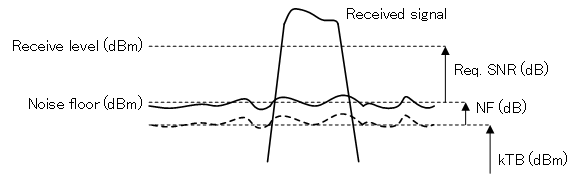
One factor affecting the ability to receive weak signals is noise. Even in the absence of external signals, a receiver will still see noise coming from its own components. These random variations are seen by the receiver on all frequencies, creating what engineers refer to as the noise floor.
 |
|
This determines the minimum required level for reception. |
|
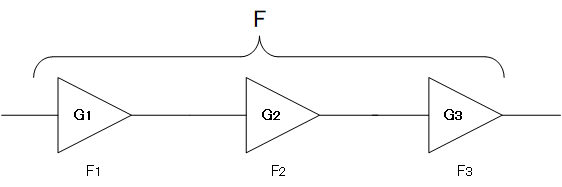
More on Noise Figure… The term “Noise Figure”, you will find in the specifications of RF components such as amplifiers, mixers etc. Thus the total noise figure in the system is important because of its impact on SNR. Every component creates a successive degradation in SNR. |
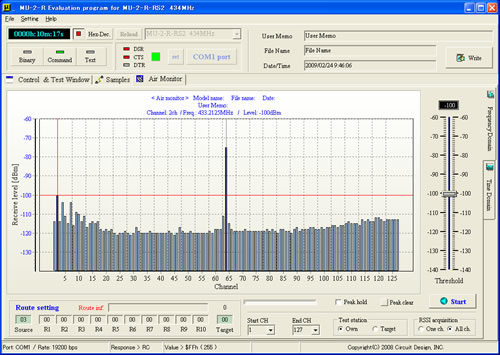
Circuit Design’s evaluation tools. By using serial commands, you can acquire the RSSI on each channel, helping you to visualise the noise floor and SNR in your communication link. |